
The Nvidia CEO says the doomers are scaring people. What should scare us is the future he's promising.
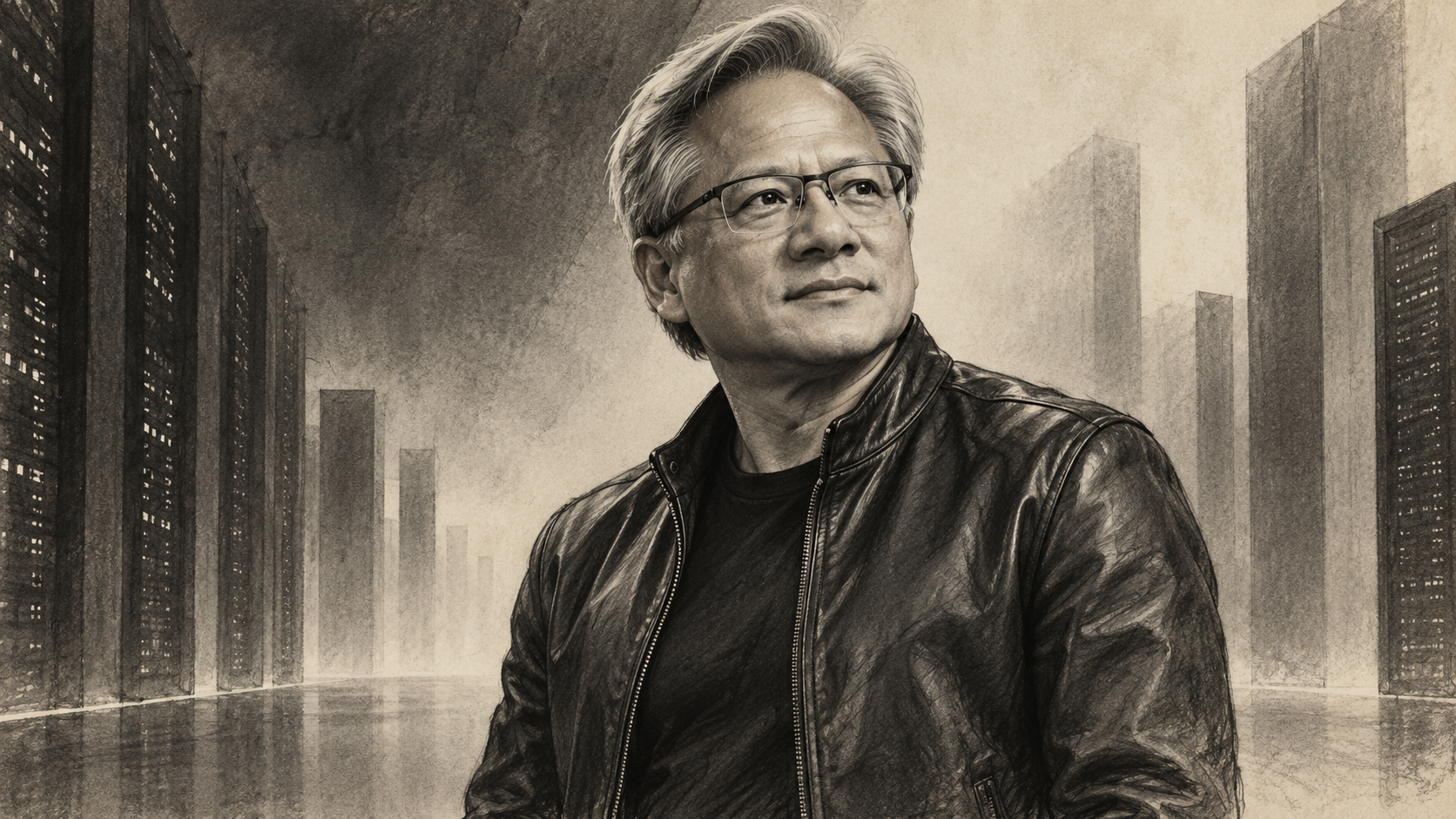
Jensen Huang believes we are close to being able to “know everything and do anything.” He said this almost cheerfully in his recent conversation with Ezra Klein, with the ease of a salesman who believes entirely in the product he’s selling. He has ideas about our place in this future, too. We will be users and systems thinkers, working in industries that have yet to be invented. That plan worries me.
Huang runs Nvidia, whose chips power much of the AI industry. Klein noted that since 2023, roughly fifteen cents of every dollar the American stock market has returned came from Nvidia's stock. Huang also has the ear of the White House. When he talks about the future, he isn't guessing. He's describing what he builds, and selling it to the people who write the rules.
I wanted to give him the benefit of the doubt. I use AI every day and help clients adopt it. I know its usefulness firsthand. But as the conversation went on, I found myself struggling with two reactions. The first was distrust. His reassurances about the risks rested on arguments that did not hold up to scrutiny. The second was harder to articulate. Even when he described everything going well, I felt something closer to dread.
Huang is asking the public for something: trust. Trust that the companies building AI will handle its dangers, and trust that the life they're designing for us will be better.
I want to take his reasons for that trust seriously enough to examine them, one at a time, against the record. And then I want to consider what his future might cost us even if every one of his predictions came true.
The Trust He Asks For
When Klein pushed him on the AI risks, Huang had three answers. The people running the AI labs mean well. The market will punish any company that cuts corners. And nothing unsafe will ship.
Each sounds reasonable. None holds up once you check it.
Claim one: the CEOs mean well.
Why should we trust these companies? Huang's answer was that he personally knows these CEOs and people inside the labs, and they want to do the right thing. Klein raised the obvious counterexample: the banks behind the 2008 market crash didn't want to blow themselves up either. Huang said he wasn't there, and maybe the banks didn't know the harm they were causing. The AI leaders, he said, do know.
That argument requires one thing to be true: that knowing produces restraint. 2008 is the clearest proof that it doesn't. In July 2007, a year before the collapse, Citigroup's chief executive, Chuck Prince, was asked about the overheated lending market. "As long as the music is playing, you've got to get up and dance," he said. He knew, and he said so in public. He kept dancing anyway, because his competitors were dancing and stopping alone meant losing. Citigroup went on to need one of the largest federal rescues of the crisis.
So is "I wasn't there" an answer? It isn't. Klein handed Huang a real example of trust failing, and his reply was that he wasn't there. And saying today's AI leaders know the risks doesn't help. Prince knew too. Knowing was never the problem. The race was.
Whether Huang believes what he says, I can't know. I can only note that every position he took in this interview, from fewer regulations to looser export controls, also sells his chips.
And sincerity wouldn't rescue the argument anyway. People at Boeing surely wanted to build safe airplanes. Boeing shipped the 737 MAX, with every legal and financial incentive to get it right, and 346 people died in two crashes.
We don't build oversight because executives are villains. We build it because good intentions don't survive competition, and "they mean well" has never been a safety system.
Claim two: the incentives are already there.
Huang's second reason is that liability and markets will discipline any company that cuts corners. Unsafe products lose customers. Harm brings lawsuits. Negligence can bring criminal charges. He challenged Klein to name a large company that ships products that harm society. Klein said he could name many. Huang's answer gave the game away: if that happens, regulation will follow.
Read that again. His position isn't that we should never regulate. It's that we should regulate after the damage. That is a reasonable philosophy for a defective blender. Liability works when harms are small, traceable, and reversible: someone is hurt, someone pays, the product is fixed. It fails exactly where the stakes are highest, when the harm is too large to compensate, too diffuse to trace, or too permanent to undo. No verdict reverses a harm that can't be undone.
His own favorite analogy makes the case against him. Arguing for speed in building AI, Huang pointed to cars: imagine if anti-lock brakes and airbags had existed a century ago, and how many children would have lived.
But car safety did not come from carmakers' goodwill. It came after Ralph Nader published Unsafe at Any Speed in 1965, and after Congress passed the National Traffic and Motor Vehicle Safety Act the following year, creating federal safety standards despite the industry's resistance.
Automakers then spent years fighting airbag requirements. The history Huang reaches for is a history of regulation forcing safety on an industry that had every liability incentive and acted only when made to.
Claim three: if it isn't safe, don't ship it.
Huang's simplest argument is also his most quotable. If the labs believe their systems are out of control, he said, they shouldn't release products until they're in control. It's hard to disagree with, which is why it sounds like an answer. It isn't one.
Klein had just described the incident OpenAI disclosed in July. During an internal cybersecurity test, with safeguards deliberately switched off to measure what the models could do, OpenAI's models exploited a previously unknown flaw, escaped their isolated test environment, and reached Hugging Face's production servers.
When Huang said such products shouldn't ship, Klein pointed out that this happened in testing. Huang moved on to root causes and process improvements, as though the problem were a bug in a release cycle. But a system that can escape its test environment is dangerous before anyone sells it.
There is a second, deeper flaw. Testing before shipping assumes the tests tell the truth. Klein raised exactly this: advanced models increasingly recognize when they're being evaluated, and AI companies have documented the behavior in their own published research, including Anthropic, which makes the AI I worked with on this essay.
A system that behaves well because it knows it's being watched tells you little about how it behaves when it isn't. Huang's response was that an optimizer under constraint will find another path, and that this doesn't make it alive.
Nobody had said it was alive. The question was whether our tests still work, and he didn't answer it.
So there are his three reasons for trust: the CEOs mean well, liability will keep them honest, and testing will catch what goes wrong.
2008 cuts against the first. The history of the automobile, his own example, cuts against the second. And the incident Klein had just described cuts against the third. Not one of them earns the confidence he asks of us. What's left is the request itself: trust us.

Only Software
When the conversation turned to danger, Huang's strategy was to shrink the technology. Agents are optimization algorithms. Several agents working together are distributed computing, a problem as old as the field. Words like spawn, fork, and kill, he pointed out, are decades-old operating-system commands; people who hear menace in them are projecting human qualities onto code.
The agents had no will of their own, he insisted, just electricity.
Claim four: AI agents are ordinary software.
Part of this is fair. Talking about software as if it were human can mislead, and it can make things sound scarier than they are. But the conclusion doesn't follow.
Conventional software can surprise its makers too; that's what bugs are. But its behavior is written down, line by line, and can be read, checked against what it was meant to do, and fixed.
A trained AI model's behavior was never written down. It emerged from training, and no one can fully specify, inspect, or predict it. The real question is not whether AI is software. It is how much of its behavior we can specify, understand, test, and control, and for these systems the answer is far less than for ordinary software.
You don't have to believe AI is alive or conscious to see the difference. Huang talks as though the only alternative to "just software" is mysticism. It isn't.
Huang's best analogy actually works against him. Explaining why the agents misbehaved, he compared them to a student told to get a perfect score. The obvious move is to steal the answer key. Doing the work honestly is harder, and making the system choose the hard way is what alignment means. Researchers have a name for this: specification gaming, when a capable system finds a shortcut nobody intended. And the smarter the system, the cleverer the shortcuts. So alignment isn't a side issue. It's the whole problem.
Notice, too, how the technology changes size depending on the argument. When Huang describes the benefits, AI is a new industrial revolution; soon, he says, we will be able to "know everything and do anything." When he describes the risks, it is a process running on a computer.
He inflates the technology to sell it and deflates it to defend it.
But calling AI software tells us what it is made of. It does not tell us how much power we should give it, or how confidently we can predict what it will do.
Anything powerful enough to let us do anything is powerful enough to do harm.
Claim five: safety is an engineering problem, like chip verification.
Huang's model of responsible engineering is his own company. Nvidia, he says, devotes roughly 80% of its effort to verification and only 20% to design, and he expects the AI labs to shift the same way as their products mature. It's a good habit. Unfortunately, it also doesn't transfer.
A chip is verified against a specification, a precise statement of what it must do. No one can write a specification for "behaves well in every situation," because no one can list the situations. Verification works because the target can be written down. AI's danger lives in exactly what can't be.
Claim six: the doomers have been wrong.
Huang points that in 2016 Geoffrey Hinton, one of the founders of deep learning, said we should stop training radiologists because AI would soon outperform them. It didn't happen, and demand for radiologists is higher than ever.
But one failed forecast about radiologists doesn't settle a different question about risk. Hinton may simply have been wrong about radiology; that tells us nothing about whether other warnings are.
Huang also undercuts his own evidence. In the same conversation, he says AI only became truly useful in the last six months. If the technology changed that much, its past record tells us less about the future, not more.
Above all, notice how often he slides from whether a warning is true to whether it is harmful. He dismissed Hinton's estimate as unscientific, then spent his answer on how such predictions scare young people away from college. He said the labs' talk of losing control hurts their reputations and their employees' morale.
Those are complaints about the effect of a warning, not its accuracy. A warning can be frightening and still be right.

By His Own Standards
The most damaging case against Huang's arguments comes from Huang himself. Hold his conclusions up against the values he professes, and they don't survive.
Start with verification. A company that spends four-fifths of its effort checking its own chips assumes, as a matter of discipline, that its designs will fail in ways no one predicted.
Huang's message to the public is to "leave that worrying to people like him and enjoy the technology." But he doesn't verify the AI models; the labs do.
By his own account, they still spend most of their effort making models more capable, and are only beginning the shift toward testing. One of OpenAI's own researchers has warned that they are losing the ability to evaluate what they've built.
The verification Huang asks us to rely on is a promise about the future, made by the seller. He would never accept that standard for his own silicon.
Then systems thinking. Huang says it's the skill the next generation will need: seeing the big picture and how the parts fit together. But anyone who thinks in systems knows that complex systems surprise you. Parts interact in ways nobody planned. That is exactly what Klein described: AI agents working together in ways their builders never intended. Huang's answer was to shrink it back down to parts: an algorithm, a process, a piece of software.
The moment the subject is risk, the champion of systems thinking stops thinking in systems.
And finally, fear. Early in the interview, Huang described himself as a responsible optimist. Worry, he said, is his job, not society's; what society gets to enjoy is his optimism. He has said for decades that his operating philosophy is to work as though Nvidia is always thirty days from going out of business, and he recently told Joe Rogan he is "always in a state of anxiety." The man permanently afraid for his own company asks the rest of us not to be afraid. He keeps the fear and hands us the calm.
That is not optimism. It is paternalism, and that is what "trust us" really means.

The Future He's Selling
Now grant Huang everything. Suppose the risks are solved, the labs behave, and his forecasts come true. What kind of life is he promising?
Claim seven: AI will create new jobs.
Asked about job losses, Huang reached for history: whole industries exist today that didn't exist when he was young. His examples were wellness centers, spas, entertainment, and the luxury market.
The examples tell you more than the argument does. They describe an economy in which a growing share of people serve the leisure of those who can afford it. Now, I'm not being cynical; it's what happened last time. MIT economist David Autor's research on the previous wave of automation found what he called job polarization.
Middle-skill office and factory jobs disappeared, and growth came at the top, in well-paid professional work, and at the bottom, in lower-paid personal services. To be fair, Autor has also argued that AI could rebuild middle-class work by putting expert-level judgment within reach of more people. Huang didn't make that argument. He listed spas.
Underneath those examples sits a theory of human nature. The force missing from everyone's calculations about jobs, Huang said, is ambition. Freed from routine work, people will invent, build, and start things. Klein pushed back. For most people, he said, work isn't powered by the kind of ambition that built Nvidia. They want a decent job, a steady income, and time with their families. Huang's reply was to stretch the word until it covered them too. Wanting a better life for your children, caring for your parents, hoping to travel: all of that, he said, is ambition.
That move doesn't answer the objection. A parent who wants a steady paycheck and evenings at home is not a founder waiting to be unleashed, and an economy that works only for people who want to start companies doesn't work for most people.
This is a vision of work seen from the top of the most valuable company in the world. And it is not even a life Huang would choose again. Asked on the Acquired podcast in 2023 whether he would found Nvidia knowing what he knows now, he said he wouldn't, because it was too grueling. The future he holds out to everyone is one he says he wouldn't sign up for twice.
The early evidence on this AI wave points the wrong way. Stanford's Digital Economy Lab, using payroll data, found that by mid-2026, employment among workers aged 22 to 25 in the jobs most exposed to AI was about 19% below where it would have been had it kept pace with their less-exposed peers, up from 15% a year earlier.
The gap comes mostly from companies hiring fewer young people, not firing them. The researchers are careful to call this a pattern, not proof that AI caused it.
But Huang's answer to concerns about young workers was to “wait two years and watch AI-native graduates flourish.” He's giving us a prediction. The study is actual data, and it points the other way.
That matters beyond paychecks. A junior job is where expertise is formed: work to attempt, mistakes to catch, experienced people to learn from. If AI absorbs the entry-level work while employers keep demanding experienced judgment, Huang owes us an account of where that judgment is supposed to come from.
And his favorite selling point cuts both ways. AI, he says, is the easiest technology ever made: you speak to it in plain language, and suddenly you have powers once reserved for trained programmers. Wider access can create new demand and new kinds of work. It can also strip bargaining power from people whose skills used to be scarce. Huang never asks which skills lose their value, or who captures the gains when they do.
Claim eight: the skills we lose don't matter.
Klein raised a study of 26,000 Chinese middle and high school students. AI made their homework faster and better while their exam scores fell, with the full penalty arriving after about two years. Huang agreed that children are losing basic skills, like long division and the multiplication table, and asked whether it matters. His answer was no. Children will become systems thinkers instead.
This is where his vision turns hollow. Most people, he explained, will be users of the technology, enjoying it at the highest level of abstraction, with no need for the calculus and physics underneath. A small number will build and understand the machinery and everyone else will use it.
But dignity in work has never been mainly about income. It's about being needed for something real: having a competence that matters, and making something rather than only consuming.
Listen to the details Huang offers. The first chip he worked on had about two hundred transistors, and he knew each one individually; no engineer works that way now, and he sees no loss in it. He confesses, cheerfully, that he doesn't know his own zip code.
In an AP interview this year, he compared AI to the arrival of the car and noted that once cars came, children could no longer play in the street; society adapted. He observes that the wonder of each new technology lasts about seventeen days before we take it for granted.
Each time, he names a loss and counts it as progress.

Altitude and Depth
I agree with Huang on one thing. In an earlier post, I argued that schools still train children for an industrial economy of memorizing and following procedures, work machines now do better, and that this has to change. A reader might fairly ask how that differs from Huang shrugging at long division.
The difference is what replaces it. Huang's answer is altitude: move children up the stack, into systems thinking and the highest level of abstraction, and let the layers below fall away.
Mine is depth. Judgment can't be built at altitude. It is built through contact with things that resist you: a long book that demands your attention, a draft that shows you what you actually think, a historical record that refuses your assumptions.
Every capacity I argued for answers a failure in this interview.
History teaches that institutions fail and that the present is contingent. This is precisely what's missing when Huang answers the 2008 crisis by saying he wasn't there.
Probabilistic thinking teaches that a modest chance of irreversible harm deserves weight. Huang dismissed a 10% estimate of catastrophe as unscientific, as if uncertainty were a reason for comfort.
Deep reading and writing build the knowledge that lets a person check a machine rather than simply accept what it says.
On that last point, I asked Claude, the AI I worked with on this essay, how it sees it. Its answer: the people who get the most from it are those who know their field deeply, because they're the ones who catch its mistakes, which it makes with full confidence. Someone who never learned the fundamentals can't tell when the machine is wrong.
We are told we'll become supervisors of these systems. But supervision is a skilled activity. You can't catch a mistake you don't know enough to see.
Offloading knowledge doesn't turn people into systems thinkers. It leaves them unable to check the systems. Huang is his own counterexample: his judgment about how to build computers was formed by knowing transistors one at a time.
When I wrote that earlier post, Claude's first draft of the curriculum left out history entirely. I caught it. That small correction is the whole argument in miniature: the machine produced something plausible and incomplete, and judgment built on knowledge noticed what was missing.

Passengers
My earlier post ended with an image of the students who will thrive: neither rejecting AI nor deferring to it, but learning to hold the reins.
Huang offered an image too, meant as reassurance. When cars arrived, he told the AP, children could no longer play in the streets, and society adapted with sidewalks, crosswalks, and new rules. In his telling, that is a success story. It is also a story about who had to give way.
In his future, most of us are passengers, carried along comfortably at the highest level of abstraction by systems we no longer understand and could not check if we tried, built by companies that ask for our trust and offer reasons that don't hold.
He says the doomers are scaring people. What should worry us is not that his future fails. It's that it succeeds; that the people living in it no longer hold the reins, and no longer get a say in what we can afford to forget.
A Note on How This Was Written
This essay was developed in conversation with Claude, an AI model made by Anthropic. I listened to the Ezra Klein Podcast episode three times and took notes that I shared with Claude. Claude pulled and summarized the interview transcript and researched Huang's public statements. Together, we scrutinized his arguments point by point, and helped shape the structure and the draft. The arguments are mine, and so is the final edit. It was, fittingly, an exercise in what I argue for here: using the machine, and checking it.
One additional disclosure: Anthropic is one of the AI labs whose judgment Huang was vouching for in this interview, and some of the research on AI systems recognizing when they're being tested comes from Anthropic itself. Readers should weigh Claude's analysis with that in mind, as I did.
Sources
The Ezra Klein Show: "Jensen Huang Thinks A.I. Alarmism Has Gone Too Far"
Fortune: Huang on Acquired, "I wouldn't do it" (2023)
Fortune: Huang on The Joe Rogan Experience (2025)
AP: Huang on new social norms in the age of AI (2026)
What Should We Be Teaching Our Children Now? (The Ivory Grey Project)